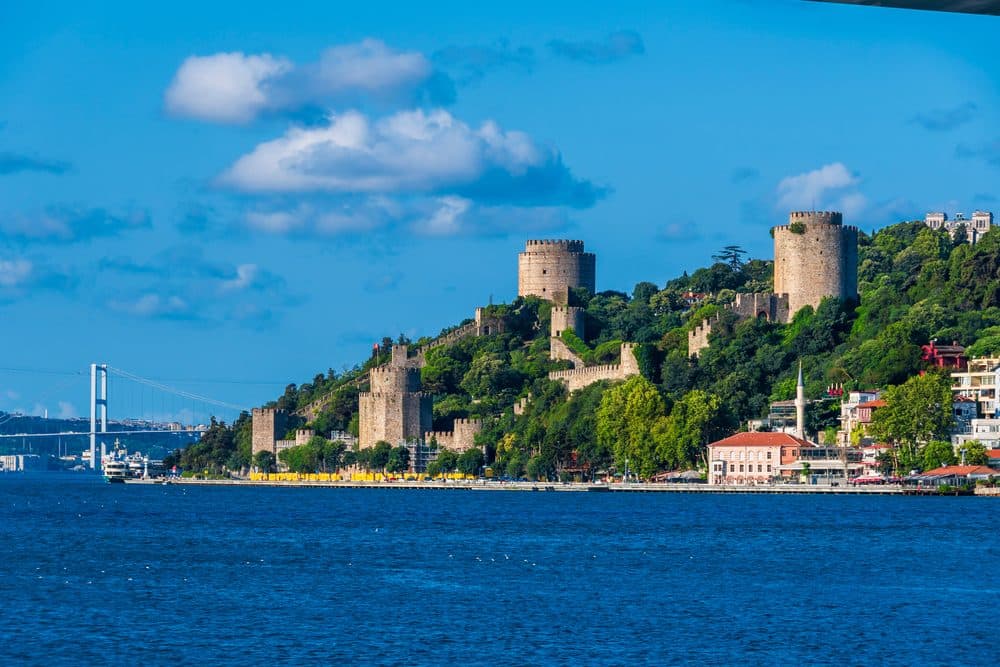
Rumeli Fortress
Complete Visitor Guide to Rumeli Fortress — The Bosphorus Fortress Built to Conquer Constantinople
1452
Year Built
3
Great Towers
4
Months to Build
01 — Why Visit
The keystone of the conquest.
Before taking Constantinople, Mehmed II built Rumeli Fortress at the narrowest point of the Bosphorus — in just four months. Three massive towers, thick stone curtain walls, and a position that let him choke off the strait entirely. Still standing today, it's a rare, tangible look at the strategic genius behind 1453.
02 — Timeline
Stone by stone, the road to conquest.
Mehmed II takes the throne and begins preparing to besiege Constantinople.
At the narrowest point of the Bosphorus, a three-tower fortress rises in just four months.
The fortress chokes off Byzantine reinforcements by sea, sealing the city's fate.
Restored and open to visitors as an open-air museum and summer amphitheatre.
03 — Experiences
Ways to explore the fortress.
Three towers, Bosphorus panoramas, and summer concerts — all in one visit.
The Three Towers
Walk Sadreddin, Halil Pasha, and Zağanos Pasha towers.
Learn more →Bosphorus Views
The most striking panoramas of the strait from the ramparts.
Learn more →Amphitheatre & Concerts
Summer concerts staged inside the fortress's open-air amphitheatre.
Learn more →Architecture
One of the best-preserved examples of Ottoman military architecture.
Learn more →Photography Guide
Best light, angles, and timing for the classic fortress shot.
Learn more →Best Time to Visit
How to dodge the crowds and catch a Bosphorus sunset.
Learn more →04 — Visit Guide
A day on the ramparts.
Three practical tips for timing your visit and routing it right.
Best hours
Arrive an hour before sunset — the light turns the stone gold and crowds thin out fastest then.
Book ahead
Summer amphitheatre events sell out fast; an e-ticket gets you straight past the queue.
Combine the route
Anadolu Fortress sits across the strait — 15 minutes by ferry or car, so compare both castles in one day.
Rumeli Fortress: Istanbul's Fortress on the Bosphorus
Rumeli Fortress (Rumeli Hisarı) is one of Istanbul's most dramatic historical landmarks — a sprawling Ottoman castle perched on the European shore of the Bosphorus Strait, in the Sarıyer district. Built in 1452 by Sultan Mehmed II, known to history as Mehmed the Conqueror, it was constructed in an astonishing four months for a single strategic purpose: to seize control of the Bosphorus and cut Byzantine Constantinople off from reinforcements and supplies arriving from the Black Sea. A year later, that blockade helped make possible one of the most consequential events in world history — the conquest of Constantinople in 1453.
Today, Rumeli Fortress is an open-air museum, and it remains one of the best-preserved examples of Ottoman military architecture anywhere in Turkey. Visitors climb its towers, walk its ramparts, and take in some of the finest panoramic views of the Bosphorus available anywhere in the city, with the Fatih Sultan Mehmet Bridge arcing across the water in the near distance.
Quick Facts
| Detail | Information |
|---|---|
| Built | 1452, in about 4 months |
| Builder | Sultan Mehmed II (Mehmed the Conqueror) |
| Towers | 3 main towers (Halil Pasha, Saruca Pasha, Zaganos Pasha) + 13 bastions |
| Ticket | €6 foreign visitors (~$7); free for Turkish citizens with Müzekart; under-12 free |
| Hours | Thursday–Tuesday, 09:00–17:00 |
| Closed | Wednesday |
| Visit length | 1–1.5 hours |
| Location | Sarıyer, European shore of the Bosphorus |
Why Rumeli Fortress Matters
Rumeli Fortress isn't just a scenic ruin — it's the physical evidence of a turning point in Mediterranean and world history. Its historic name, Boğazkesen, literally means "strait-cutter" or "throat-cutter," a blunt description of its function: nothing moved through the Bosphorus without the fortress's permission. Paired with the older, smaller Anadolu Hisarı fortress directly across the water on the Asian shore, Rumeli Fortress let the Ottomans choke off the strait completely, isolating Constantinople in the months before the final siege.
Learn more about the full story on our history page, discover exactly who built Rumeli Fortress and why Mehmed chose this precise location, and read a deeper look at the fortress's role in the conquest of Constantinople.
What You'll See on a Visit
Inside the fortress walls, three massive towers dominate the site, each named for the vizier who supervised its construction — Halil Pasha, Saruca Pasha, and Zaganos Pasha. Thirteen smaller bastions and connecting curtain walls link the towers together, forming an irregular but formidable perimeter that follows the contour of the hillside down to the water's edge. A 20th-century amphitheatre was added inside the grounds and has historically hosted open-air concerts and cultural events during the summer months — it's worth checking current listings before your visit, as event schedules vary by season.
Climbing the towers rewards visitors with sweeping views up and down the Bosphorus, across to the Asian shore, and toward the graceful span of the Fatih Sultan Mehmet Bridge. For photographers, sunset is a particularly rewarding time to visit, when the fortress stone glows warm against the darkening water. See our full what to see guide for a room-by-room breakdown.
Planning Your Visit
A visit to Rumeli Fortress is straightforward to plan and pairs naturally with a half-day exploring Istanbul's northern Bosphorus neighborhoods. Here's what you need to know before you go:
- Tickets: Entrance costs €6 for foreign visitors (around $7) as of 2026; Turkish citizens enter free with a valid Müzekart and children under 12 always enter free. One ticket also covers Yedikule Fortress and Anadolu Hisarı. See our tickets page for the latest pricing guidance and purchasing tips.
- Hours: Open Thursday through Tuesday, 09:00 to 17:00; closed all day Wednesday. Full details, including seasonal notes, are on our opening hours page.
- Duration: Budget 1 to 1.5 hours for a relaxed walk through the towers and grounds.
- Nearby attractions: The upscale seaside neighborhood of Bebek, with its cafés and waterfront promenade, sits a short walk away. Emirgan Park, Boğaziçi University, and the Aşiyan Museum are all within easy reach for a longer Bosphorus itinerary.
Getting There
Rumeli Fortress is reached from central Istanbul by bus along the Bosphorus coast road, or by ferry to Bebek or İstinye followed by a short walk or local bus connection. Traffic along the coast road can be heavy at peak times, so allow extra travel time, especially in summer. If you're combining your visit with other Bosphorus-side sights, an early morning start helps you beat both the crowds and the midday heat.
A Landmark Worth the Trip
Rumeli Fortress rewards visitors who want more than a quick photo stop. Its scale, its setting directly on the water, and its direct connection to one of history's most dramatic sieges make it a highlight for anyone interested in Ottoman history, military architecture, or simply spectacular Bosphorus views. Whether you're planning a focused half-day history trip or folding the fortress into a longer day exploring Sarıyer and Bebek, Rumeli Hisarı is one of Istanbul's most rewarding heritage sites — and one of its most photogenic.
Start planning with our detailed guides: history, tickets, opening hours, and what to see once you're inside the walls.